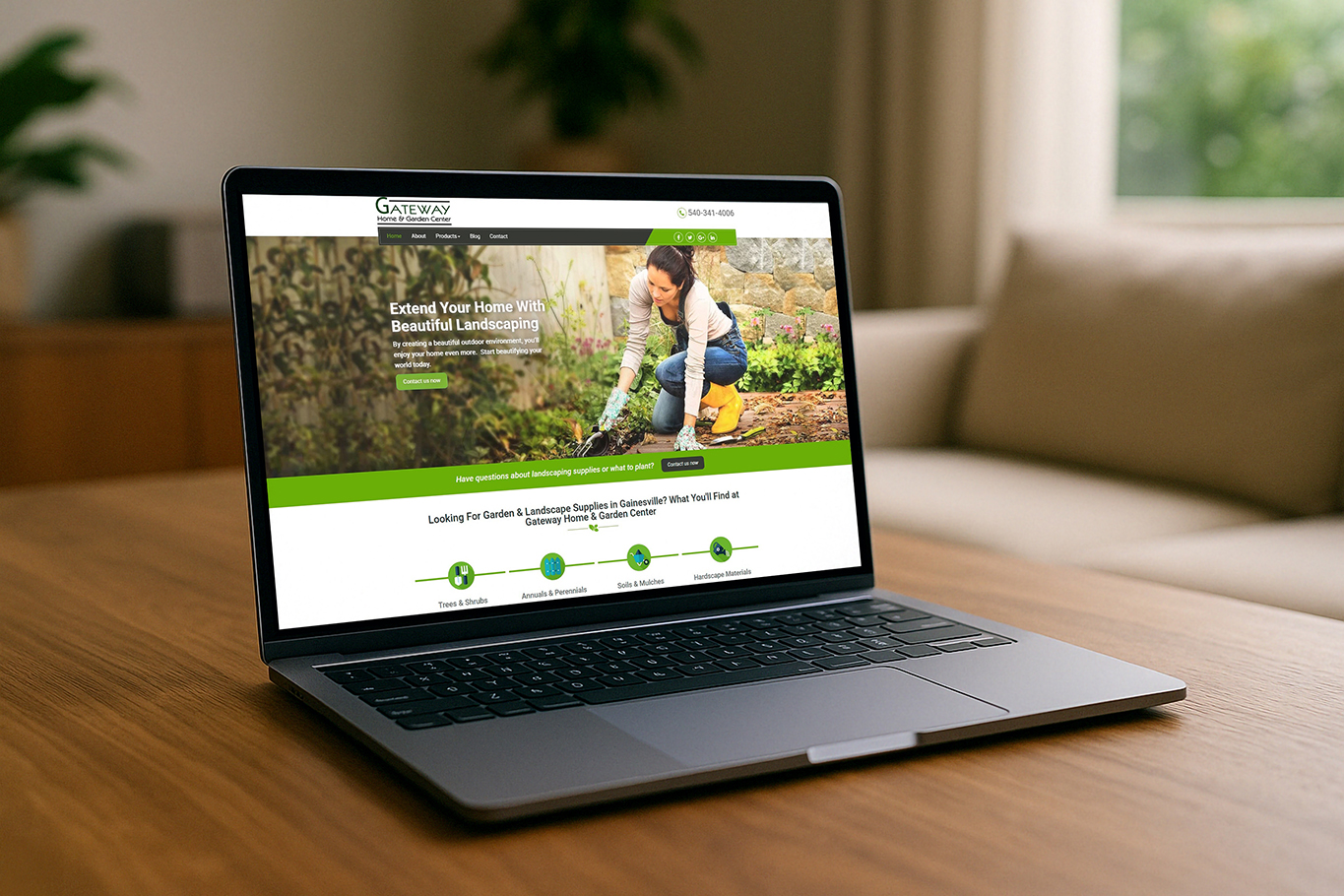
Landscape Materials Supplier Case Study
Client Overview & Challenges
Client: Landscape Materials Supplier
Industry: Landscape supply (bulk mulch, stone, topsoil), B2B & B2C
Geography: Mid-Atlantic, U.S.
Business Model: Wholesale and retail sales of bulk landscaping materials, both residential and commercial.
The client was already one of the region’s largest mulch, stone, and topsoil suppliers, but despite strong offline recognition and established distribution, their online presence wasn’t delivering. Their digital channel was underutilized, with multiple challenges:
- High bounce rates for key organic search terms (i.e. visitors arriving but leaving almost immediately)
- Sparse quality backlink profile, which limited SEO authority
- Little to no social media presence or branding amplification
- Poor PPC conversion rates, meaning ad spend wasn’t translating into leads or sales
- Manual, phone-based ordering that consumed 6–15 minutes per order and created friction for customers
They needed a comprehensive, integrated digital strategy: not just more traffic, but more qualified traffic, better conversions, and automation of sales workflows.
Strategy & Execution
We adopted a three-phase approach (though in practice the phases overlapped and iterated) to address the leaky funnel, weak online presence, and conversion friction.
Phase 1: Audit & Baseline Metrics
- Performed a deep web analytics audit to understand existing traffic sources, user flow, bounce segments, and conversion bottlenecks
- Reviewed technical SEO factors (site structure, crawlability, mobile performance, page speed)
- Evaluated PPC accounts, ad groups, landing pages, and conversion tracking
- Mapped the buyer’s journey (residential vs. commercial) to identify critical conversion paths
- Benchmarked against industry competitors and best practices
This diagnostic work established clear baselines and helped us prioritize efforts where gains would be highest.
Phase 2: Website Redesign & Conversion Optimization
- Launched a new website optimized for user experience, clarity, and conversion (e.g., simplifying navigation, clarifying product categories, improving CTAs)
- Integrated a custom shipping module so customers could get accurate freight/shipping quotes (reducing friction)
- Created content hubs (product detail pages, usage guides, comparison pages) to improve SEO relevance
- Implemented CRO (conversion rate optimization) techniques: A/B testing of forms, button copy, trust signals (testimonials, certifications), and information architecture
- Added analytics instrumentation (micro-conversions, funnel tracking, event tracking) so we could see where users dropped off in the path to purchase
Phase 3: Branding, Traffic Generation & Funnel Optimization
- Rolled out an SEO program (on-page optimization, content marketing, link building) focused on target keywords (e.g. “bulk mulch delivery mid-Atlantic,” “landscape stone supplier”)
- Enhanced the PPC campaigns (Google Search, Display, possibly remarketing) with refined targeting, better copy, and conversion-oriented landing pages
- Launched social media branding efforts to support content reach, awareness, and engagement
- Reallocated and optimized the PPC budgets over time, using data (cost per conversion, lifetime value) to guide adjustments
- Iteratively refined all tactics: ad targeting, keyword filters, negative keywords, landing page treatments based on performance data
Results & Impact
The outcomes speak to both top-of-funnel growth and operational transformation:
- Following the website launch and campaign rollout, traffic increased, and bounce rates declined
- The site generated 72,847+ product orders (bulk items) since launch (starting March 2015)
- Over time, year-over-year sales have grown as the marketing system matured
- The automation and online ordering reduced the burden on phone-based order taking, saving resources for the supplier and time for customers
- The robust analytics and ecommerce data allowed the supplier to analyze product demand by region, optimize production schedules, and guide inventory decisions
- The marketing investments began to yield measurable ROI, with improved conversion rates on PPC, better-qualified organic leads, and more efficient spend
In qualitative terms, the project gave the Landscape Materials Supplier a digital presence that matched their offline dominance, turning their website into a revenue engine, not just a brochure.
Key Learnings & Best Practices
From this engagement, several lessons stand out - both for our team and for other businesses running digital strategy in product-heavy, B2C/B2B hybrid industries:
- Measure first, act later
The audit and baseline phase is essential. If you don’t know where users are dropping off, you’ll optimize in the dark. - Solve buyer friction, not just traffic gaps
Giving accurate shipping quotes, reducing phone-order dependence, clarifying product options -these micro improvements often yield outsized gains. - Data-driven media allocation
Continuously shift budget toward the highest-converting channels or landing pages, even if that requires pulling from underperforming campaigns. - Integrate the tech stack & analytics
You need tracking, attribution, and funnel visibility. Without instrumentation (events, goals, ecommerce funnels), you can’t detect leaks or optimize meaningfully. - Iterate, don’t set-and-forget
Search, PPC, CRO all need ongoing testing, optimization, and refreshes. What works in month 1 may underperform in month 6 if ignored. - Leverage data for operational insights
Marketing is not siloed, the demand data coming from online can inform production, fulfillment, and inventory decisions.