

In May 2026, Google announced what its own VP of Search called the biggest upgrade to the search box in more than 25 years. It is a full AI redesign, built around a new model, autonomous “search agents,” and an AI Mode experience that has already crossed one billion monthly users. If you have ever refreshed a keyword ranking report or watched a Google Analytics graph, this update touches you directly. Here is what changed, why some of the SEO metrics we have reported on for years are becoming less meaningful, and why that is not the bad news it might sound like.
What Google Actually Announced
At Google's 2026 I/O conference, VP of Search Elizabeth Reid confirmed that AI Mode has surpassed one billion monthly users, with query volume more than doubling every quarter since launch. Google is rolling out an AI-powered search box (its biggest redesign of the search box in over two decades), plus new “search agents” that work in the background around the clock and expanded conversational follow-up directly inside AI Overviews. You can read Google's own announcement here: Google's official I/O 2026 Search announcement.
In plain terms: Google is no longer just a list of ten blue links. Increasingly, it is an answer engine that reasons across the web, synthesizes a response, and only sometimes sends a visitor on to a website afterward.
Why “SEO” Is Becoming “AIO”
For two decades, digital visibility meant one thing: ranking on page one of Google. That still matters, but it is no longer the whole game. As one recent industry analysis put it, this is the shift from SEO to AIO, Artificial Intelligence Optimization, and it is reshaping strategy for every business with a website. Where SEO was about helping search engines index your pages, AIO is about helping AI systems understand, trust, and quote your content when someone asks a question. In short: SEO gets you found, AIO gets you chosen.
Why Traffic That Used to Reach Your Website No Longer Does
For years, the path was predictable: someone searches a question on Google, clicks into a blog post or service page to read the answer, and if your content earned their trust, they call, fill out a form, or make a purchase. That path is breaking down, and not for just one reason. Here is where that traffic is actually going:
- AI Overviews answer the question directly on the results page. If the summary at the top of Google fully satisfies the searcher, there is no reason for them to scroll down to your listing at all, let alone click it.
- A growing share of research now starts somewhere other than Google. People are asking ChatGPT, Perplexity, or Google's own AI Mode their question directly, comparing options inside that conversation, and never generating a search on the Google results page your rankings live on in the first place.
- Google's new “search agents” can complete the task for the user, researching, comparing, and in some categories even calling a business or booking an appointment, without the user ever visiting a website themselves.
- Conversational follow-up keeps people inside the AI Mode interface. Instead of clicking back to Google to refine a search and click a new result, users now ask a follow-up question right inside the AI answer and stay there.
Google's own announcement confirms this is by design, not a side effect: AI Mode has surpassed one billion monthly users, and Google is actively building agents that research and even transact on a person's behalf.
The Numbers Behind the Shift
This is not a theory. It is already showing up in click-through data:
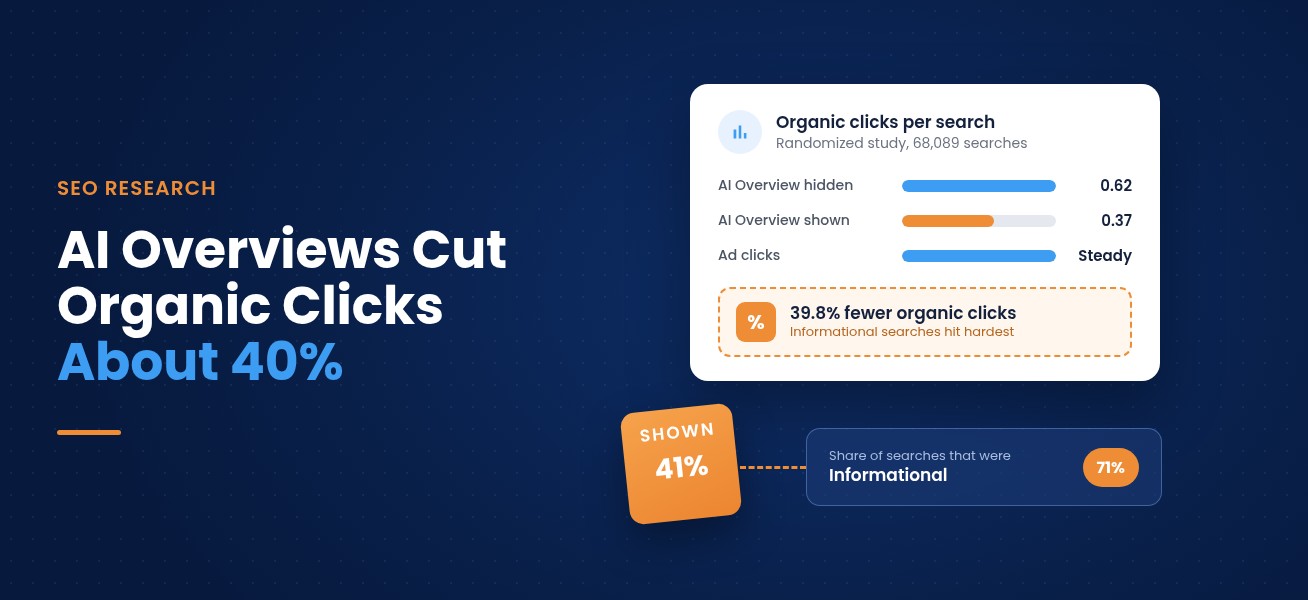
- Organic click-through rates for search queries with an AI Overview dropped 61% between mid-2024 and September 2025, based on a Seer Interactive study of over 3,100 queries and 25.1 million impressions.
- Even queries without an AI Overview saw organic click-through rates fall 41% over the same period, meaning people are simply clicking less overall.
- 58% of U.S. adults now encounter an AI-generated summary somewhere in their Google results, and they click through to a website less often when one appears (Pew Research Center).
- An estimated 60% of Google searches now end without a single click to any website.
Source: Forbes Technology Council, “The Shift From SEO to AIO”
Your Keyword Count and Search Console Impressions Will Shrink Too
Two other numbers you are used to watching every month are changing for the same underlying reason, not because your content got worse.
Fewer keywords ranking. Traditional rankings assume one webpage answers one specific search phrase. AI Overviews and AI Mode do not work that way. They break a single question into many smaller questions behind the scenes, then blend information from several sources into one synthesized answer.
Where your site used to hold separate top 10 rankings for a dozen close variations of the same question, Google may now resolve all of those variations inside a single AI answer that cites only a handful of sources. The keyword count in your rank tracker can shrink even though your visibility has not actually gone away. It has just moved from “ranking for a phrase” to “being one of the sources an AI answer cites.”
Fewer impressions in Search Console. Search Console counts an impression when your listing appears in a Google results page for a given query. As more informational searches get resolved entirely inside an AI Overview or AI Mode conversation, without the classic ten-blue-links page loading the same way, there are simply fewer opportunities for your listing to register that impression at all. Some businesses will see the reverse pattern instead: impressions holding steady or even climbing while clicks fall, because Google now credits multiple cited sources within an AI Overview for the same query. Either way, the relationship between impressions, rankings, and actual visits is no longer as tidy as it used to be, which is exactly why we are adding AI citation tracking to your reporting rather than relying on any single number.
What This Means for Your KPIs
If your monthly report shows rankings holding steady or even improving while impressions, keyword counts, and organic sessions decline, that is not necessarily a sign that anything is broken. It is the industry-wide effect of AI answers absorbing clicks and consolidating queries before a searcher ever reaches a results page in the traditional sense. Traditional KPIs like keyword position and raw impression counts are becoming less reliable stand-ins for business health. We are shifting our reporting to include AI citation tracking and share-of-voice inside AI answers alongside the metrics you are used to, so you can see the whole picture rather than a shrinking slice of it.
It's also worth noting that the June 2025 and March 2026 Core Updates changed the underlying logic Google uses to judge relevance. These updates represent a real departure from older SEO playbooks, as Google has grown far more willing to overlook or downrank content it once would have surfaced without hesitation. With more sophisticated targeting in place, Google now passes over dated posts, thin write-ups, and generic AI-generated summaries in favor of substantive, well-researched material. Instead of rewarding pages built to satisfy a crawler, the algorithm increasingly filters toward content that demonstrates real first-hand experience, original data, and a tight match to what the searcher actually intended.
The practical effect is that companies are losing ground on keywords where their content no longer holds up as the most credible, verified, or on-point answer available.
The Silver Lining: Fewer Visitors, Better Visitors
Here is the part that should not get lost in the headlines. Research from Semrush found that the average AI search visitor converts at a rate 4.4 times higher than the average traditional organic search visitor. By the time someone reaches your site from an AI answer, they have typically already compared options and understood your value proposition. They are not browsing; they are deciding. Fewer, better-qualified visitors can produce more revenue than a larger number of casual clicks, even if the traffic graph looks smaller. (Semrush, “We Studied the Impact of AI Search on SEO Traffic”)
There is also encouraging news for businesses that have already invested in solid SEO. The same Semrush research found that AI systems still cite pages that rank well in traditional search more often than lower-ranking pages, so the technical SEO and content foundation we have already built for your site continues to pay off. It is a foundation to build on, not a foundation to abandon.
There is a second reason for optimism that is specific to businesses like yours: search intent. AI Overviews show up overwhelmingly on informational searches, the “what is,” “how to,” and “why does” questions where a summary genuinely satisfies the searcher. Commercial and transactional searches, the ones that actually drive your business, such as “get a quote,” “schedule an appointment,” or “roofing company near me,” are far less likely to trigger an AI Overview in the first place, because an AI summary cannot actually book the job, sign the contract, or take the payment for the user. Someone ready to hire or buy still has to leave the AI conversation and land on a real website to take that next step. That is exactly the kind of traffic your service pages and contact forms are built to capture, and it is the traffic most resistant to what AI Overviews are doing to informational content.
AI Platforms Are Starting to Sell Ads Inside the Answer Itself
There is another piece of this shift worth understanding, because it changes what “making up for lost traffic” actually looks like. The same AI platforms that are keeping searchers from clicking through to your website are moving quickly to sell advertisers a seat inside that answer instead:
- Google already runs ads inside AI Overviews and, as of Google Marketing Live 2026, is testing new Gemini-powered formats built to live directly inside AI Mode responses rather than beside them. This includes ads that appear as a recommendation inside an AI-generated list, and a conversational ad format where a Gemini-powered chat agent qualifies a buyer right inside the search results page.
- OpenAI began testing ads in ChatGPT in February 2026 for signed-in Free and Go tier users, clearly labeled and placed below the AI's answer. By May 2026, OpenAI opened self-serve access to every U.S. business, with no minimum spend and cost-per-click bidding starting in the $3 to $5 range.
- Not every AI platform is racing in the same direction. Perplexity tested ads for over a year and then walked away from advertising entirely in February 2026, telling the Financial Times that ads risk making users “doubt everything” about the answer's objectivity. Anthropic has made a similar public commitment to keeping Claude ad-free.
You can see Google's own description of these new formats here: Ads in AI Mode, from Google. And for more on how the major AI platforms are splitting into ad-supported and ad-free camps, see this comparison of AI search advertising across ChatGPT, Google, and Perplexity.
This is not a niche experiment. Industry analysts project U.S. AI search ad spend to grow from roughly $1 billion in 2025 to nearly $26 billion by 2029, or about 13.6% of all search ad spend. That said, users are not entirely comfortable with it yet. A recent Ipsos survey found that nearly two-thirds of U.S. adults say ads inside AI search results make them trust the results less, which is worth keeping in mind before leaning too heavily on any one AI ad surface.
Why You Should Increase (and Redirect) Your Advertising Now
If organic clicks are structurally shrinking, particularly on the informational searches that used to feed your blog traffic and some service pages, paid media needs to pick up more of the load. A few practical moves:
- Shift ad budget toward transactional and commercial keywords, the “get a quote,” “schedule an appointment,” and “[service] near me” searches that still reliably send clicks, rather than spreading spend across broad informational terms that are losing clicks industry-wide regardless of ad presence.
- Start testing Google's new AI Mode ad formats now, while competition and cost-per-click are still relatively low. Being an early advertiser inside a new surface has historically paid off, the way early Google Ads and early Facebook ads did for the businesses that got in first.
- Keep your Google Business Profile, service pages, and product data clean and specific. Gemini pulls directly from that information to generate the on-the-fly explanation behind these new ad formats, so vague or outdated listings work against you here just as much as they do in organic results.
- Consider a small test budget on ChatGPT's now self-serve Ads Manager if your customers skew younger or you sell a consumer product, since there is no minimum spend required to get in.
- Treat this as a genuine reallocation, not just added spend. Money that used to be aimed at broad blog promotion may now do more for you aimed at bottom-funnel ad placements on Google and, selectively, inside AI answer surfaces.
We are already building this into the paid media conversations we have with clients, and it is worth a conversation about your account specifically.
What Conversion Pipeline Is Doing About It
For every client of ours, we’ve been adapting the way we produce and structure content for a while now:
- Writing content utilizing Google EEAT, Rank Brian and Generative Engine Optimization best practices. When appropriate we’ll include clear, direct answers to specific questions in each page, so AI systems can lift a clean, quotable answer.
- Expanding JSON-LD schema (FAQ, HowTo, LocalBusiness, Service) so AI systems and search engines both understand what your business does and where it operates.
- Building topical depth around your services instead of isolated one-off blog posts, since AI systems favor comprehensive, well-linked content clusters.
- Adding AI citation and share-of-voice tracking to your monthly reporting, alongside your existing rankings and analytics.
If you want a closer look at how we are building this into new service pages, our team recently published updated AEO and GEO focused service page covering exactly this shift.
What You Should Do Next
- Do not panic if you see rankings or impressions dip in the coming months. Look at leads and conversions alongside them.
- Ask us to walk you through AI citation tracking on your next monthly report. Although this isn’t always completely accurate, reporting technology is getting better.
- Keep investing in content depth and structured data. It is the foundation AI systems are actually citing from.
This is the biggest change to search in a generation, and we are already ahead of it for our clients. If you want to talk through what it means for your business specifically, reach out to our team and we will walk you through this with you.
Free audits
Find out where your ad spend and leads are leaking
Our free PPC audit digs into your Google Ads account for wasted spend, weak tracking and missed opportunities. Want the bigger picture? A free lead-source mini-audit shows which channels actually bring in your calls and form fills.