













Every day your Shopify store operates below its potential conversion rate is revenue that isn’t coming back. The good news is that most conversion issues are identifiable and fixable once someone takes a close, structured look at your store’s data and user experience.
Let’s take that look together. Schedule a free consultation with our team and we’ll walk through your store, talk through where you’re likely losing sales, and outline what a dedicated Shopify CRO strategy could look like for your business — no pressure, no obligation.
Conversion rate optimization is the structured process of increasing the percentage of store visitors who complete a desired action — most often making a purchase, but also adding to cart, creating an account, subscribing, or starting a checkout. On Shopify specifically, CRO combines platform expertise (theme architecture, app performance, checkout customization, Shopify Plus capabilities) with classic conversion psychology: trust signals, friction reduction, clear value communication, and persuasive design.
Unlike a one-time redesign, CRO is a continuous, testable discipline. It relies on analytics, session recordings, heatmaps, customer feedback, and controlled A/B tests to determine what actually changes buyer behavior — as opposed to what merely looks better in a mockup. That distinction matters, because plenty of “improvements” that seem obvious on paper end up hurting conversion rate once real customers interact with them.
Most ecommerce stores are leaving significant revenue on the table without realizing it. Industry benchmarking data puts the global average ecommerce conversion rate somewhere between roughly 1.6% and just under 3%, depending on the source and time period measured, meaning the overwhelming majority of visitors to any given store leave without buying. Conversion rates also vary enormously by category — some verticals convert under 1%, while others convert well above 6% — which is exactly why generic, one-size-fits-all advice so often falls flat. A strategy that lifts conversion for a jewelry brand can be the wrong move for a food and beverage store.
A few realities make dedicated Shopify CRO especially important right now:
In other words, CRO isn’t a “nice to have” add-on to your marketing. It’s the multiplier that determines how much value you actually capture from every other channel you invest in.
We approach every engagement as a partnership, not a one-off audit. Here’s what that looks like in practice.
Across the stores we’ve worked with, a handful of issues show up again and again:
If any of these sound like your store, there’s a strong chance you’re already losing sales you could be capturing with the right fixes.
Conversion Pipeline is a full-service digital advertising and branding agency, which means Shopify CRO doesn’t happen in a silo for us — it’s informed by the same team that understands your SEO, your paid advertising, your content, and your brand positioning. That matters, because the most effective conversion fix is sometimes on the page, and sometimes it’s a mismatch between what your ads promise and what your landing page delivers.
We take an individualized approach to every store we work with. Your product category, price point, customer base, and traffic sources are all different from the next merchant’s, which is why we don’t apply cookie-cutter playbooks. Instead, we build a CRO strategy around your store’s actual data and your business goals, and we stay hands-on as your dedicated point of contact throughout the process — not a rotating cast of account managers.
Our team works with agencies and direct clients alike, based out of Fairfax, Virginia and Nashville, Tennessee, and serving ecommerce businesses nationwide. Whether you’re running a growing Shopify store or managing ecommerce for multiple clients, we bring the same rigor, transparency, and results-driven mindset to every engagement.
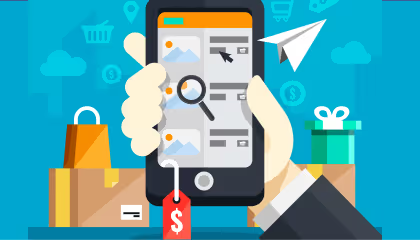
Search ads allow you to target users who are actively searching for your product or service. Whether it’s Google Search, Shopping, or local ads, we ensure your brand appears at the right moment — when buyer intent is at its highest.
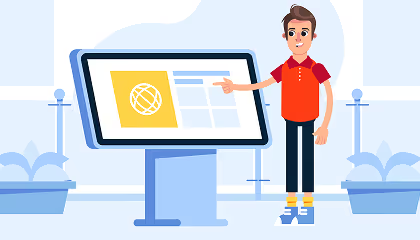
Through display campaigns, your brand can appear on relevant websites to increase visibility and drive top-of-funnel traffic. Our team carefully selects high-performing placements based on audience behavior, website relevance, and cost efficiency.
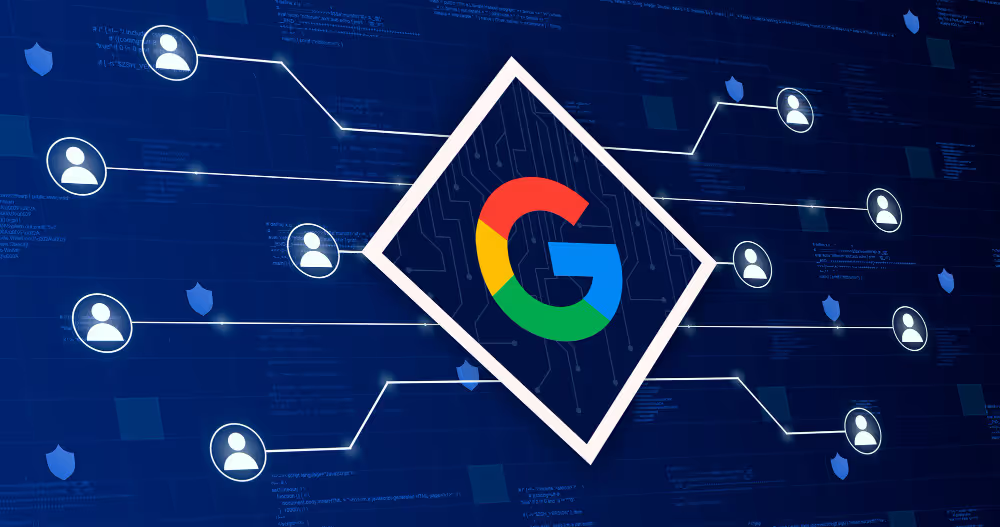
Conversion Pipeline is a Google Partner which is a designation reserved for only a small percentage of all Google Partners. All Google Partners must meet Google’s strict requirements in three main areas: Certification, Ad Spend, & Performance. Net Result: It takes us less time to implement and manage a profitable ad campaign for our clients.
Re-engage users who have already visited your website or interacted with your brand. Remarketing campaigns consistently outperform cold traffic by reminding potential customers to come back and convert.
Reach known customers using the data they’ve shared with your business. We can target users based on name, email, phone number, or address across Google, YouTube, Gmail, Facebook, LinkedIn, and more.
Video content is now essential for engagement. With platforms like YouTube — the second-largest search engine — your brand can leverage targeted video ads to educate, inspire, and convert. We create sleek, engaging video campaigns that drive results.

With more than 50% of web traffic coming from mobile devices, your ads must be optimized for mobile viewing and performance. We create high-impact mobile campaigns that convert across apps, browsers, and social platforms.
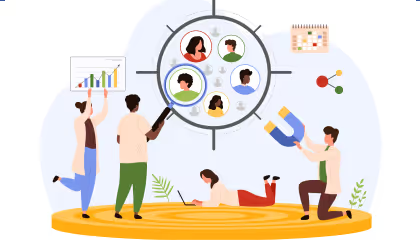
Lookalike or “similar” audiences is a digital targeting strategy based on user data lists such as email and remarketing audiences that allows the advertiser to find similar users who match certain attributes of your best-performing audiences. Google, Facebook and other platforms use machine-learning algorithms to analyze a source audience to find shared member characteristics then finds new users with similar characteristics to target. The best way to see how valuable lookalikes audiences are is to split test them against your normal website traffic and view the different results.
Paid social campaigns require more than just boosted posts. We build strategic campaigns across Facebook, Instagram, LinkedIn, Pinterest, and more — tailored to your audience and business goals. From lead generation to brand awareness, we align platform selection and messaging with measurable outcomes.
It depends heavily on your industry, price point, and traffic mix, so there’s no single universal benchmark. Rather than chasing an arbitrary number, we help you benchmark against your own category and focus on steady, measurable improvement over time.
Initial audit findings and quick-win fixes can often be implemented within the first few weeks. Meaningful, statistically reliable A/B test results take longer and depend on your store’s traffic volume — higher-traffic stores can validate changes faster than lower-traffic ones.
Yes. We work across the Shopify ecosystem, including Shopify Plus, and adapt our approach to the specific theme, app stack, and checkout customization options available on your plan.
No. Our CRO recommendations are designed to complement your existing brand and marketing efforts, and we’re happy to collaborate directly with your internal team or other vendors.
Higher traffic makes formal A/B testing faster, but even lower-traffic stores benefit significantly from a conversion audit, behavioral analysis, and evidence-based UX improvements that don’t require a controlled test to justify.
I went through 3 different online marketing companies for training and marketing services before finding Conversion Pipeline. They built my website and manage my email and online marketing activities. They continually make us money.
Conversion Pipeline greatly improved and expanded our online marketing strategy. We found new locations to promote our school, increased student enrollment and raised our brand awareness among distinguished members of the academic and medical communities.
Conversion Pipeline’s redesign of our website and digital marketing services have made a significant, positive impact on our business. We’ve seen impressive increases in website conversions, leads and new business as result of their efforts.
When I started My Exterminator, I called Conversion Pipeline to build my Google AdWords campaign from the ground up. Competing with much larger, national exterminator companies, I needed to ensure my Ad was found.
We participate in Conversion Pipeline’s SEO Training Program once a year. We saw immediate results once we implemented the strategies we learned in the SEO training program.

Conversion Pipeline has done much better work for me than large companies with a supposed national reputation. I’m top in Google for bankruptcy lawyers in Northern Virginia and their work has helped me stay there.