













ChatGPT advertising rewards the businesses that show up early and test seriously. If you're ready to find out whether it belongs in your paid media mix, let's talk.
ChatGPT advertising is OpenAI's paid placement program inside ChatGPT itself. OpenAI began testing ads with Free and ChatGPT Go users in the U.S. in February 2026, then expanded through the year into Canada, Australia, New Zealand, the UK, and additional markets. Ads appear as clearly labeled “Sponsored” placements, visually separated from ChatGPT's own responses — OpenAI has been explicit that sponsored content does not influence the answers the model gives.
Businesses reach these placements through OpenAI's self-serve Ads Manager, or through agency and technology partners, bidding on a cost-per-click or cost-per-thousand-impression basis — a bidding structure that will feel familiar to anyone who has run Google or Meta campaigns. What's genuinely new is the targeting model: ads are matched to conversation topics and context rather than keywords, cookies, or third-party audience segments, and advertisers never see the contents of a user's chat — only aggregate performance data. Paid ChatGPT subscribers (Plus, Pro, Business, Enterprise, and Education) don't see ads at all, which means every campaign is reaching a specific, high-volume slice of ChatGPT's user base.
Sponsored placements can surface inside a ChatGPT response when the model detects commercial intent in the conversation — for example, a fencing-supply ad appearing while a user asks ChatGPT about building a fence. Every placement is labeled as sponsored and kept visually distinct from ChatGPT's own answer.Targeting draws on the current conversation, and — where a user has opted in — their broader chat history and memory, along with past ad interactions. None of that raw chat content is shared with advertisers; brands see impressions, clicks, and post-click outcomes, not what a user actually typed. Bidding runs through an auction, with advertisers setting cost-per-click or cost-per-impression bids, daily budgets, and pacing inside Ads Manager, and measuring results through OpenAI's Conversions API, pixel, and supported mobile measurement partners for app-based goals.
Because ChatGPT ads sit inside a conversation rather than a search results grid or a social feed, the creative that wins looks different too: shorter, more conversational, and written to answer a question rather than interrupt one.
We handle ChatGPT advertising the same way we handle every paid channel — as a managed, accountable service, not a one-time setup.
Conversion Pipeline is proud to be a Google Partner — a distinction reserved for only the top-performing digital agencies. This status means:
We review your business goals, current paid media performance, and audience to confirm ChatGPT advertising is worth the investment.
We configure your Ads Manager account, tracking, and initial campaign structure around clear, measurable goals.
We launch with multiple creative and targeting variations, since this is still an emerging channel with limited established benchmarks.
We shift budget toward what's working, refresh creative to stay ahead of fatigue, and scale spend as performance data accumulates.
You get straightforward reporting tied to pipeline and revenue, not just platform vanity metrics, on a cadence that matches the rest of your paid media program.
We're not a single-platform shop learning paid media for the first time on your budget. Conversion Pipeline already plans, builds, and manages paid campaigns across Google, Meta, and connected TV/geofencing for mid-market and professional services companies, and we run that work inside the same RevOps-minded framework we bring to ChatGPT advertising: every channel is judged on pipeline and revenue it produces, not clicks or impressions in isolation.
That matters more on a new channel like this one, not less. ChatGPT advertising doesn't yet have a decade of industry benchmarks to lean on, so the agencies that treat it as a real, measured line item — with clear goals, disciplined testing, and honest reporting — are the ones who will find what works before it becomes obvious to everyone else.
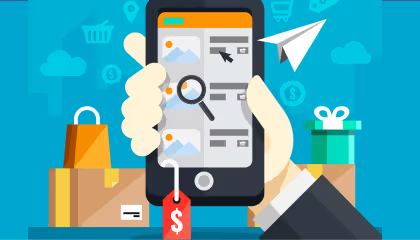
Search ads allow you to target users who are actively searching for your product or service. Whether it’s Google Search, Shopping, or local ads, we ensure your brand appears at the right moment — when buyer intent is at its highest.

Through display campaigns, your brand can appear on relevant websites to increase visibility and drive top-of-funnel traffic. Our team carefully selects high-performing placements based on audience behavior, website relevance, and cost efficiency.
Conversion Pipeline is a Google Partner which is a designation reserved for only a small percentage of all Google Partners. All Google Partners must meet Google’s strict requirements in three main areas: Certification, Ad Spend, & Performance. Net Result: It takes us less time to implement and manage a profitable ad campaign for our clients.
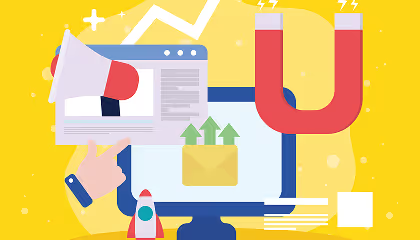
Re-engage users who have already visited your website or interacted with your brand. Remarketing campaigns consistently outperform cold traffic by reminding potential customers to come back and convert.
Reach known customers using the data they’ve shared with your business. We can target users based on name, email, phone number, or address across Google, YouTube, Gmail, Facebook, LinkedIn, and more.
Video content is now essential for engagement. With platforms like YouTube — the second-largest search engine — your brand can leverage targeted video ads to educate, inspire, and convert. We create sleek, engaging video campaigns that drive results.

With more than 50% of web traffic coming from mobile devices, your ads must be optimized for mobile viewing and performance. We create high-impact mobile campaigns that convert across apps, browsers, and social platforms.
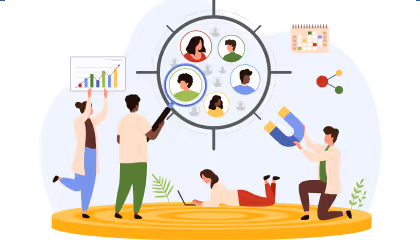
Lookalike or “similar” audiences is a digital targeting strategy based on user data lists such as email and remarketing audiences that allows the advertiser to find similar users who match certain attributes of your best-performing audiences. Google, Facebook and other platforms use machine-learning algorithms to analyze a source audience to find shared member characteristics then finds new users with similar characteristics to target. The best way to see how valuable lookalikes audiences are is to split test them against your normal website traffic and view the different results.
Paid social campaigns require more than just boosted posts. We build strategic campaigns across Facebook, Instagram, LinkedIn, Pinterest, and more — tailored to your audience and business goals. From lead generation to brand awareness, we align platform selection and messaging with measurable outcomes.
Pricing runs on a cost-per-click or cost-per-thousand-impression auction, similar in structure to Google or Meta Ads. Entry requirements and typical bid ranges have been changing quickly as OpenAI expands the platform in 2026, so we confirm current numbers with you and OpenAI before recommending a budget.
Ads currently show to Free and ChatGPT Go tier users. Paid subscribers — Plus, Pro, Business, Enterprise, and Education — do not see ads. OpenAI also excludes accounts predicted to belong to users under 18 and avoids sensitive categories like health and politics.
It tends to work best for businesses whose customers already research or compare options conversationally — retail, home services, financial services, travel, and professional services, among others. We assess fit as part of our initial strategy and feasibility work rather than assuming every business should be on every new channel.
The bidding mechanics are familiar, but the targeting and creative are not. ChatGPT matches ads to conversation context rather than keywords or audience segments, advertisers never see chat content, and ad copy has to work inside a conversational answer instead of a results page or a social feed. That's a different creative and targeting discipline, even where the underlying auction logic looks similar.
Plan on new creative. Search and social ad copy is written to stop a scroll or win a click on a results page; ChatGPT ad copy has to read naturally inside a synthesized answer. We typically adapt your existing messaging and offers into shorter, conversational variations built for this format.
ChatGPT advertising is a new and fast-changing platform. Ad formats, pricing, and eligibility detailed above reflect OpenAI's program as of August 2026 and are subject to change as OpenAI continues to roll the platform out; we confirm current program details with every client before launching a campaign.

I went through 3 different online marketing companies for training and marketing services before finding Conversion Pipeline. They built my website and manage my email and online marketing activities. They continually make us money.
Conversion Pipeline greatly improved and expanded our online marketing strategy. We found new locations to promote our school, increased student enrollment and raised our brand awareness among distinguished members of the academic and medical communities.

Conversion Pipeline’s redesign of our website and digital marketing services have made a significant, positive impact on our business. We’ve seen impressive increases in website conversions, leads and new business as result of their efforts.
When I started My Exterminator, I called Conversion Pipeline to build my Google AdWords campaign from the ground up. Competing with much larger, national exterminator companies, I needed to ensure my Ad was found.

We participate in Conversion Pipeline’s SEO Training Program once a year. We saw immediate results once we implemented the strategies we learned in the SEO training program.

Conversion Pipeline has done much better work for me than large companies with a supposed national reputation. I’m top in Google for bankruptcy lawyers in Northern Virginia and their work has helped me stay there.