
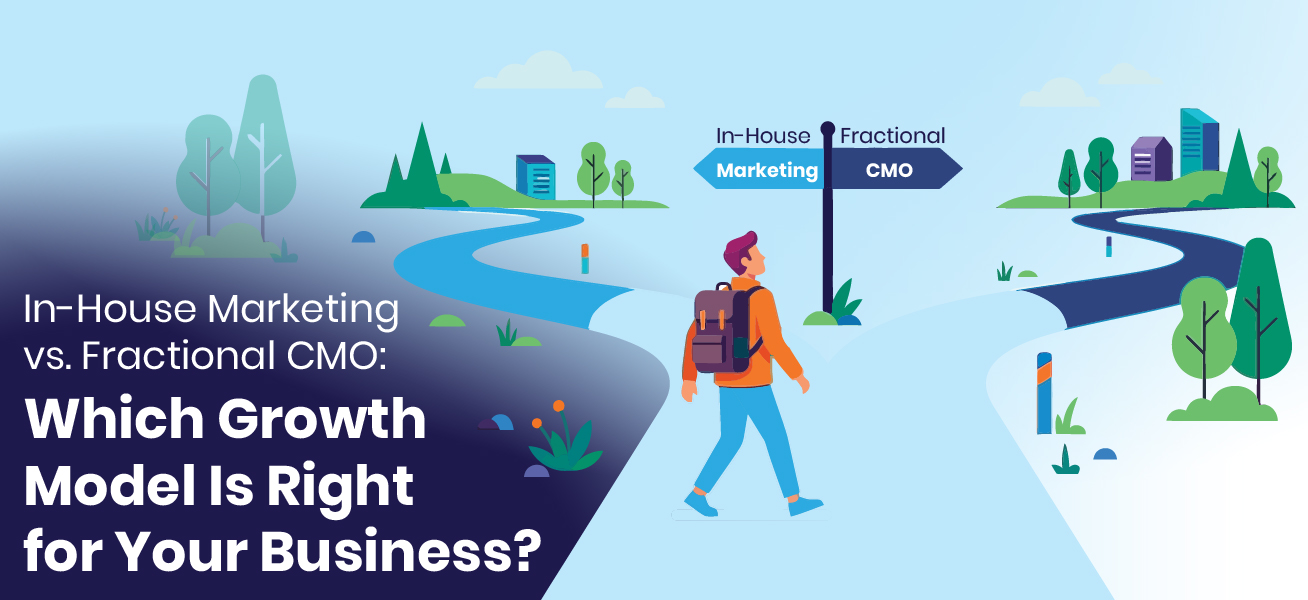
Every growing company eventually hits the same wall: marketing needs outpace the team's capacity to deliver. When that happens, leadership usually faces one of two paths — build a full in-house marketing department, or bring in a fractional Chief Marketing Officer (CMO) to provide senior strategy without the full-time price tag.
There's no universally “right” answer. The best model depends on your budget, growth stage, and how quickly you need results. In general, an in-house team is the stronger fit once you have proven channels and need daily, hands-on execution embedded inside the company. A fractional CMO is the stronger fit when you need senior-level strategy, faster decision-making, and flexible leadership without committing to a six-figure executive salary. Below, we break down the real pros and cons of each so you can match the model to where your business actually stands today.
What Is In-House Marketing?
In-house marketing means hiring marketers directly as full-time (or part-time) employees who work exclusively on your brand. Depending on company size, this can range from a single marketing generalist to a full department with specialists in SEO, paid media, content, design, and marketing operations, often reporting up to a Chief Marketing Officer or VP of Marketing.
What Is a Fractional CMO?
A fractional CMO — sometimes called a virtual CMO or outsourced CMO — is a part-time, senior marketing executive who works with your business on a contract basis, typically anywhere from a few hours a week to several days a month. Rather than executing every tactic personally, a fractional CMO sets strategy, aligns marketing with revenue goals, manages vendors and internal staff, and brings the judgment of someone who has already scaled marketing at other companies. Many businesses bring one on for a specific stretch, such as after losing a CMO, launching into a new market, or needing an outside audit of an underperforming marketing program.
Pros of In-House Marketing
- Deep institutional knowledge. In-house marketers live inside your business every day. Over time, they develop an intuitive understanding of your customers, sales cycle, and brand voice that's difficult for any outside resource to match immediately.
- Full attention and availability. Your team works exclusively for you, not split across other client engagements. That means faster turnaround on ad hoc requests and more availability for real-time collaboration with sales, product, and leadership.
- Long-term culture fit. Full-time employees tend to build stronger cross-departmental relationships over time, which helps marketing initiatives get buy-in and stick.
- Direct control. You control hiring, performance management, and day-to-day priorities without needing to coordinate through a third party.
Cons of In-House Marketing
- High fully loaded cost. A single in-house marketing manager can run $170,000–$180,000 fully loaded once benefits, taxes, and overhead are included, and that's before adding specialists in paid media, content, or design. A full-time CMO is a much bigger commitment: base salaries alone commonly range from roughly $190,000 to well over $300,000 depending on company size and geography, and the fully loaded first-year cost of a mid-market CMO — including bonus, equity, and benefits — often lands between $600,000 and $1.2 million.
- Slow ramp time. New in-house hires typically need two to six months to fully understand the business and start delivering results, all while you're already carrying full salary and benefits costs.
- Narrow skill coverage. Very few individual hires are simultaneously excellent at SEO, paid advertising, content, marketing automation, and strategy. Building full-channel coverage in-house usually means multiple hires, which multiplies cost.
- Turnover risk. Losing a senior in-house marketing leader can stall momentum for months while you recruit a replacement, and specialized marketing talent is expensive and time-consuming to replace.
Pros of a Fractional CMO
- Executive strategy at a fraction of the cost. Fractional CMO engagements in 2026 typically range from about $4,000–$8,000 a month for early-stage support up to $15,000–$25,000+ a month for senior operators managing complex, scaling programs — generally 40–70% less than the fully loaded cost of a full-time CMO at a comparable experience level.
- Faster time to impact. Because a fractional CMO has already built and run marketing programs elsewhere, many engagements show measurable improvements to strategy, technical foundations, and visibility within the first 30 days, rather than the two-to-six-month ramp typical of a new full-time hire.
- Broad, senior-level expertise. Fractional CMOs typically bring years of experience across multiple companies and industries, which means pattern recognition about what works (and what doesn't) that a first-time in-house hire may not have.
- Flexibility. Engagements can scale up for a product launch or market expansion and scale back down once a program stabilizes — a level of flexibility a full-time salary doesn't allow.
- Objective, outside perspective. A fractional CMO isn't tangled in internal politics or sunk-cost thinking about past campaigns, which often leads to more candid recommendations.
Cons of a Fractional CMO
- Limited hours. Because a fractional CMO is splitting time across clients, they're not available for every day-to-day fire drill the way a full-time employee would be.
- Execution still needs a home. A fractional CMO sets strategy and oversees execution, but someone — whether that's your internal team, an agency, or a mix of both — still needs to do the hands-on work of running campaigns and producing content.
- Less built-in institutional memory. Because the engagement is part-time, it can take slightly longer for a fractional CMO to absorb every nuance of your internal culture compared with someone who sits in the building full time — though this gap narrows quickly once the engagement matures.
- Requires clear scope. Because fractional engagements are contract-based, results depend heavily on setting clear expectations, deliverables, and communication cadence up front.
Cost Comparison at a Glance
In-House
Typical monthly cost: ~$14,000–$25,000+ per specialist/executive (fully loaded)
Time to first results: 2–6 months
Commitment: Full-time salary, benefits, taxes
Channel coverage: Limited to hires made
Fractional CMO
Typical monthly cost: ~$4,000–$25,000, scaled to need
Time to first results: Often within 30 days
Commitment: Flexible retainer, scalable up or down
Channel coverage: Broad strategic oversight, often paired with specialists
Figures are directional 2026 market ranges and will vary by company size, industry, and geography.
A Third Option: The Hybrid Model
Many growing companies don't choose one model exclusively — they combine them. A common structure pairs an in-house marketing coordinator or small internal team (who understand the day-to-day business) with a fractional CMO who sets strategy, manages outside vendors and agencies, and reports progress to the CEO. This hybrid approach captures the institutional knowledge of an internal team with the senior strategic oversight of an experienced marketing executive, often at a lower total cost than a full in-house department led by a full-time CMO.
How to Decide Which Model Fits Your Business
Do you already have proven marketing channels that just need more hands to execute?
If yes, in-house hires focused on execution may be the better investment.
Do you need senior strategic direction, but can't justify a $200,000+ full-time executive salary yet?
A fractional CMO typically delivers better ROI at this stage.
Have you recently lost a marketing leader and need continuity while you figure out your next move?
A fractional CMO can fill the gap immediately without rushing a permanent hire.
Is your marketing budget flat or under pressure?
Industry-wide marketing budgets have held roughly flat as a share of company revenue in recent years, which means efficient structure — not simply adding headcount — is increasingly the real lever for performance.
Frequently Asked Questions
Can a fractional CMO eventually become a full-time hire?
Yes. Many companies use a fractional CMO specifically to validate the role, build the strategy, and identify the right full-time candidate before making a permanent hire.
Does a fractional CMO replace my marketing team?
No. A fractional CMO typically works alongside your existing team or agency partners, providing strategic direction rather than replacing day-to-day execution.
Is a fractional CMO only for startups?
No. Fractional CMOs work with companies of all sizes, from early-stage startups needing their first strategic marketing hire to established mid-market businesses that need senior oversight without adding another full-time executive.
How long do fractional CMO engagements typically last?
Engagements range from a few months for a specific project (such as a market launch or marketing audit) to ongoing, multi-year relationships functioning as long-term marketing leadership.
The Bottom Line
In-house marketing offers control, full-time availability, and deep institutional knowledge, but comes with a high fully loaded cost and a slower ramp to results. A fractional CMO offers senior-level strategy, faster impact, and significant cost savings, but works best when paired with a team — internal or outsourced — that can execute the strategy day to day. For many growing businesses, the right answer isn't either/or; it's sequencing the two so that strategic leadership and execution capacity grow together.
This article was prepared by the team at Conversion Pipeline, a Google Partner digital marketing agency operating since 2009 with offices in Fairfax, VA and Nashville, TN. Conversion Pipeline provides fractional CMO services alongside SEO, paid media, and marketing automation for clients across home services, legal, healthcare, financial services, and government contracting. Learn more about our Fractional CMO services.