

By Michael Delpierre, Conversion Pipeline Published October 2026. Last updated October 8, 2026.
According to Invoca’s 2026 Home Services Lead Conversion Benchmarks Report, only 52% of calls to home-services businesses reach a person. HVAC companies in that data answered 34%. Invoca sells call-tracking and AI answering software, and the figures are averages across its own customers, so treat 52% as a benchmark to test yourself against, not a verdict on your company. The number that matters is yours. Below is the math we use to put a dollar figure on missed calls, how we measure the real answer rate with call tracking, and what contractors can fix this month.
What Invoca’s report actually says
The report, published in July 2026, covers nine home-services segments. The headline numbers:
- 52% of all inbound calls were answered by a person.
- 65% of calls longer than 15 seconds were answered, and 73% of calls longer than 30 seconds. Those cutoffs filter out misdials and quick hang-ups.
- 38% of answered calls were leads, and 45% of those leads converted on the call.
- 55% of home-services businesses didn’t ask leads to buy or book the job.
The spread between trades is wide. PPC Land’s breakdown lists plumbing at 74%, pest control at 73%, carpeting at 65%, home security at 57%, lawn and trees at 54%, doors and windows at 53%, restoration at 51%, HVAC at 34% and construction at 32%.
Read the 52% with some caution
We’d use this report, but not blindly. Three caveats:
- It’s a vendor report. Invoca’s recommendations point toward the product category it sells. PPC Land called this out directly.
- The home-services sample size isn’t disclosed. The report draws on a broader dataset of more than 70 million calls across 10 industries, but it doesn’t say how many of those are home services.
- The 52% includes junk. Misdials and two-second hang-ups drag the headline number down. The 30-second figure (73%) is closer to “real callers who wanted to talk to you.”
Ask most owners and they’ll guess they answer nearly every call. The only way to know is to measure it.
How to calculate what missed calls cost you
Here’s the formula. Plug in your own numbers.
- Monthly inbound calls from all marketing sources
- × your miss rate (1 minus your answer rate)
- × your lead rate (the share of calls that are actual job opportunities)
- × your close rate on leads
- × your average ticket
A worked example with made-up numbers: say a Nashville HVAC company gets 400 calls a month and answers 60% of them. That’s 160 missed calls. If missed callers look like answered callers and Invoca’s averages hold (38% are leads, 45% of leads book), that’s about 61 lost lead opportunities and roughly 27 jobs. At a $600 average ticket, that’s around $16,000 a month in revenue at risk.
Now be honest about it. Some of those callers leave a voicemail or call back. If half of them come back, the real loss is closer to $8,000 a month. That’s still real money going to whoever answered next.
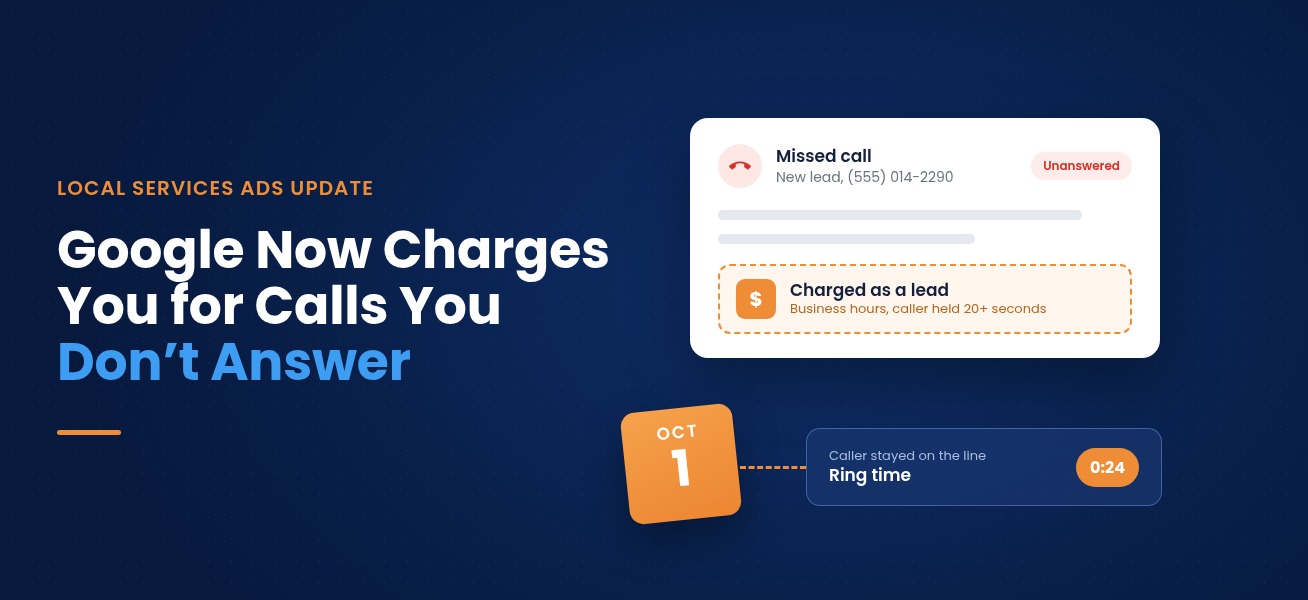
If you run Local Services Ads, there’s a second cost. Since October 1, Google charges for missed business-hours calls when the caller stays on the line more than 20 seconds, per its How leads work page. So on LSA, some of those misses are paid leads you never spoke to.
How we measure your real answer rate with call tracking
Guessing doesn’t work here. This is the process we run with CallRail call tracking:
Put a tracking number on every source
Google Ads, your Google Business Profile, organic search, Facebook, direct mail, the truck wrap. Dynamic number insertion swaps the number on your website based on where the visitor came from. Without this, you can see missed calls but not which ad dollars they came from.
Pull 60 to 90 days of call data
We look at total calls, answered, missed, voicemails and first-time callers separately. Repeat customers calling about an invoice shouldn’t count the same as a new homeowner with a dead AC.
Chart misses by hour and day
This is where the leak usually shows itself. Invoca’s report names the usual suspects: Monday mornings, the first cold snap, the after-storm rush. For a company with one or two people in the office and an owner in the field, lunch hour is often worse than after hours.
Check how fast missed first-time callers get a callback
A missed call returned in five minutes is a very different problem from one returned the next morning. Look at the time gap, not just whether a callback happened.
Listen to a sample of answered calls
CallRail’s recording and conversation intelligence features let you score calls without listening to every one. We check one thing first: did the person on the phone ask to book? If Invoca’s 55% figure holds anywhere near your shop, that’s revenue lost after the phone was answered.
CallRail’s plans run from $50 to $195 a month as of 2026, and our call tracking page breaks down what each tier includes. Calls can also flow into GA4 and Google Ads and into HubSpot, so you can tie a call to a booked job instead of a click.
Fixes, cheapest first
- Fix your hours. Make your Google Business Profile and ad schedules match when someone actually answers.
- Add an overflow ring group. A second phone that rings after three rings costs almost nothing.
- Pause ads you can’t answer. Invoca’s own advice is to pause high-volume paid campaigns during windows you can’t book, unless something is answering those calls.
- Answer the easy questions on your website. Clear service-area pages and an FAQ cut low-value calls. Our conversion rate optimization work and website chatbots that handle FAQs and appointment booking are built for this.
- Add an answering service or AI agent for overflow. Worth it if it books jobs. Less so if it only takes messages.
- Coach the ask. A short script that ends with “Can I get you on the schedule for Thursday morning?” is free.
Frequently asked questions
What is a good call answer rate for a home services business?
Invoca’s 2026 benchmark puts the home-services average at 52% of all calls and 73% of calls over 30 seconds, with plumbing at 74% and HVAC at 34%. Aim to beat your trade’s benchmark on calls over 30 seconds and track it monthly.
How do I find out how many calls my business misses?
Use call tracking software such as CallRail with a unique number for each marketing source. Its reports show answered, missed and voicemail calls by source, day and hour.
How much do missed calls cost a contractor?
Multiply your missed calls by your lead rate, close rate and average ticket. With 160 missed calls a month, a 38% lead rate, a 45% close rate and a $600 ticket, the revenue at risk is roughly $16,000 a month before callbacks.
Is the Invoca 52% statistic reliable?
It’s a useful benchmark, but it’s a vendor report built from averages across Invoca’s own customers, and the home-services sample size isn’t disclosed. Measure your own answer rate before acting on it.
Do missed calls cost money on Google Local Services Ads?
Yes. Since October 1, 2026, Google charges for missed calls during your business hours when the caller stays on the line for more than 20 seconds.
Get your real answer rate in one 15-minute call
Our free lead-source mini-audit shows you where your calls come from, how many you’re missing, when it happens and what it’s likely costing you. If you don’t have call tracking yet, we’ll tell you exactly what to set up first. Then we’ll walk through it together on a 15-minute call.
Call Carl Pappas at 877-877-0542 or book your mini-audit here. We’re at 818 18th Avenue South in Nashville, and you can see more about our Nashville digital marketing services and home services marketing.
About the author: Carl Pappas is Sales Director at Conversion Pipeline, a U.S.-based, in-house digital marketing agency and Google Partner with offices in Nashville (818 18th Avenue South) and Fairfax, Virginia. He works with home services companies, plastic surgery and medical practices, real estate teams, auto dealers and B2B firms on Google Ads, Local Services Ads, SEO and AI search visibility, call tracking and HubSpot, and he leads the agency’s free lead-source mini-audits for Middle Tennessee businesses.