By Michael Delpierre, CEO, Conversion Pipeline Published November 12, 2026.
On November 10, 2026, OpenAI announced Businesses in ChatGPT, a beta program that lets companies claim their organization, keep their information current, and review aggregated insights on how people engage with them inside ChatGPT. OpenAI says ChatGPT now reaches 1.2 billion people each week.
If you have ever claimed a Google Business Profile or opened Search Console, the shape of this launch will look familiar. Google taught businesses to come onto its platform to manage how they appear, then offered paid products once those businesses were already there. OpenAI is opening a similar door. Companies will log into Business Hub to claim a profile and read their numbers. Once they are inside, OpenAI has a direct path to offer paid services, starting with ChatGPT Ads and sponsored Business Agents.
What OpenAI Actually Launched
Businesses in ChatGPT has three parts.
A claimed profile inside Business Hub. Eligible businesses in places where ChatGPT is available can claim their organization, complete verification, and then update key details. Retailers can add self-service product feeds with pricing and availability. Shopify merchants can connect a store from Business Hub or the Shopify admin, and eligible products from Shopify Catalog are already integrated into ChatGPT. Existing OpenAI Enterprise customers and advertisers can work with their OpenAI representative to claim their business. According to OpenAI's help documentation, you do not need an ads account or a ChatGPT Enterprise agreement to claim an eligible business.
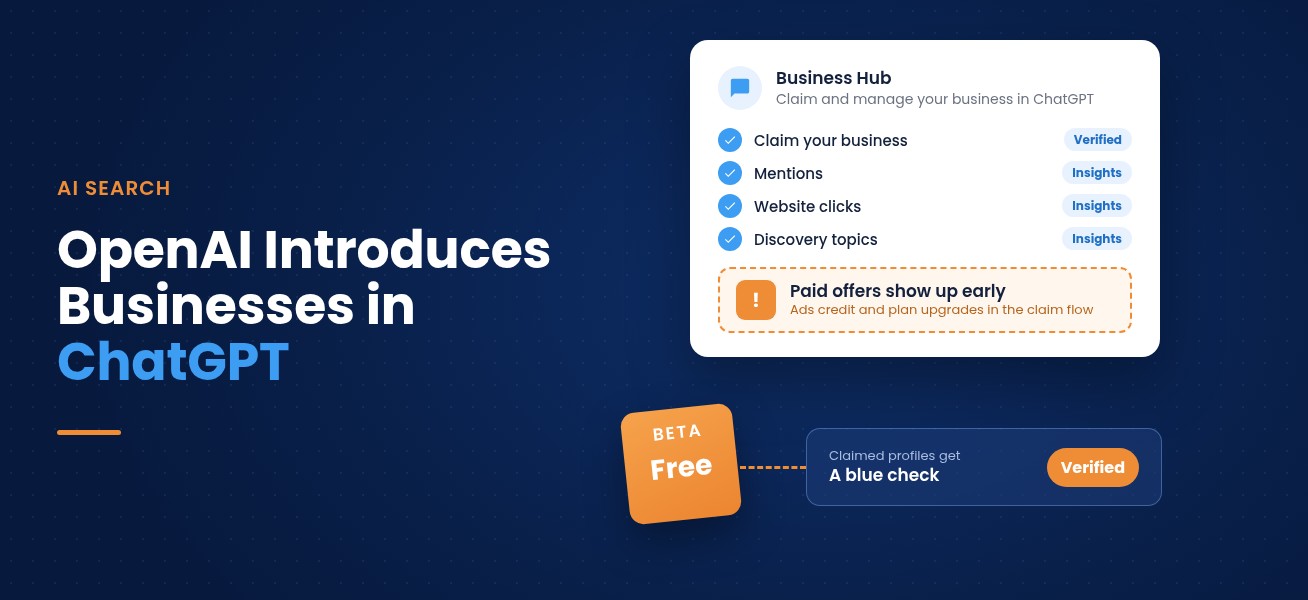
A claimed profile receives a blue check. OpenAI is clear that claiming does not guarantee higher placement or more sales, and that ChatGPT still makes its own recommendations and comparisons.
Insights on engagement, including website citations. Business Hub provides aggregated insights, including the number of mentions and website clicks a business receives. Businesses can also review discovery topics, which OpenAI describes as common themes across conversations where their website is cited. Insights appear only when there are enough conversations or interactions to meet privacy thresholds. OpenAI says it does not share users' conversations or Business Agent chats with businesses.
This is the closest thing ChatGPT has offered to a Search Console-style view of AI answers, and it is more specific than a simple brand mention report. OpenAI's help documentation says that for an online business, a mention counts when ChatGPT references the website. Naming the brand alone does not count. For a local business, a mention counts when ChatGPT shows a result for that location, even if the person does not open the listing or visit the site. Discovery topics are grouped themes, not individual customer questions.
Business Agents, with a paid option beside them. After a business is claimed, eligible ecommerce and online service businesses in the United States can build, test, and launch a Business Agent. When a business appears in a model response, a person can open its ChatGPT profile and, if an agent is available, start a separate, clearly labeled conversation with the business. That chat is distinct from the original ChatGPT thread and from ChatGPT's own answers. The current agent cannot complete purchases, make bookings, or look up a customer's order. It can explain products and policies and send people to the website.
Businesses can also sponsor their Business Agent and use it as a destination for ChatGPT Ads. Sponsored placements are clearly labeled and kept separate from ChatGPT's regular responses. The announcement does not list a price for claiming a profile, using Business Hub, or publishing an unsponsored agent. Digiday's coverage of the launch briefing reported that Business Hub and unsponsored agents are free for now, while sponsored placements are paid. OpenAI plans to expand both products to more markets and business categories over time.
How to Claim Your Business in ChatGPT
Here is the claim process as it appears in Business Hub today, using Conversion Pipeline as the example. The steps are short, and the paid offers show up early.
1. Search for your business
Business Hub opens with the line "Reach new customers and grow your business with ChatGPT." Type your business name into the search box. A search for "Your Business" returns several Your Business listings in different cities, so you need to choose the correct location before you start the claim.

2. Start the claim
Selecting a listing opens a window titled "Claim Your Business in ChatGPT." OpenAI says a claimed profile lets you see how often the business is mentioned in ChatGPT conversations, show customers what you offer, and help them decide with a business agent. You also have to verify that you are authorized to represent the business before you can continue.

3. The claim goes under review
After you submit the claim, OpenAI shows a review screen. "Claim received" is marked complete, "Review in progress" is underway, and OpenAI says it will email its decision to the account address, or ask for more information if needed. On the same screen, OpenAI already offers a path to switch to a ChatGPT Business plan.

4. The claim is approved
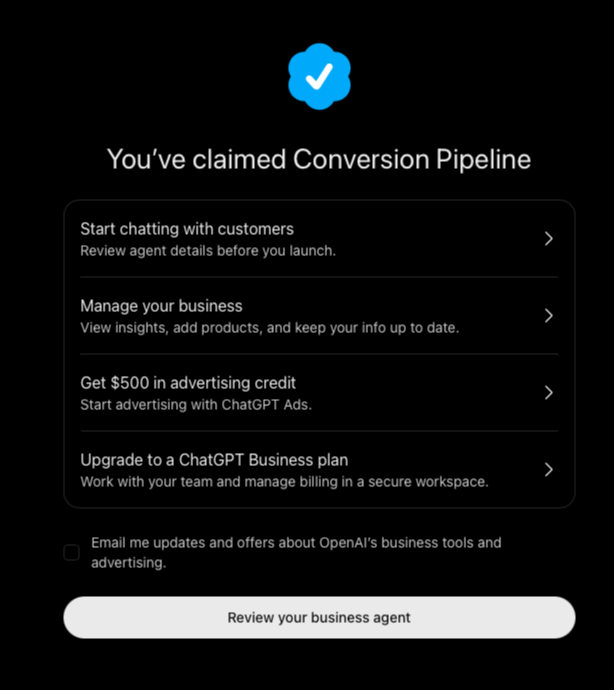
Once the claim is approved, the confirmation screen says "You've claimed Your Business." The next options include starting a chat with customers, managing the business, getting $500 in advertising credit to start advertising with ChatGPT Ads, and upgrading to a ChatGPT Business plan.
5. Open the Business Hub dashboard
The Business Hub dashboard shows the claimed listing and three Brand insights metrics: Mentions, Profile views, and Website clicks, with 7-day and 28-day views. Those figures are blank here, which matches OpenAI's approach of holding back numbers until there is enough activity to meet its privacy thresholds. Before you can edit business info or publish a business agent, OpenAI requires identity verification with a government-issued ID. The dashboard also prompts you to reach more people and upgrade to a ChatGPT Business plan.

A Playbook Google Already Wrote
Google Business Profile taught local companies to claim a listing, keep details accurate, and watch how people find them on Maps. Search Console taught marketers to look at queries, clicks, and the pages Google cites. Google Ads sits next to both, ready when a business wants more visibility than the free tools provide.
Businesses in ChatGPT follows that pattern. The unpaid work is claiming the profile, supplying accurate information, and reading mentions, clicks, and discovery topics. The commercial work is ChatGPT Ads and sponsored agents. Enterprise customers are already in the claim flow through their OpenAI representative. That is how a widely used consumer product becomes a place where businesses show up, measure results, and eventually spend money.
The claim flow makes that commercial path easy to see. As soon as the listing is approved, OpenAI offers $500 in advertising credit to start running ChatGPT Ads, plus an upgrade to a ChatGPT Business plan. Those same paid options appear again in the Business Hub dashboard.
"OpenAI is taking this straight out of Google's playbook. Get businesses to claim their profile and check their numbers, and once they're in the dashboard, the ads and paid upgrades are one click away."
Michael Delpierre, Conversion Pipeline
Why This Matters in the Race for Business Customers
OpenAI is not only competing for consumer usage. It is competing for companies that will pay to use its models and, now, to reach buyers inside ChatGPT.
That is a market where Anthropic has held a lead in enterprise model spending. In its November 2026 report, 2026: The State of Enterprise AI, Menlo Ventures estimated that Anthropic's share of enterprise LLM API spend rose from 40% to 55%, while OpenAI's share rose from 27% to 31% and Google's fell from 21% to 9%. Those figures are estimates of dollars spent on production API usage among surveyed U.S. enterprise buyers, not a count of how many companies use each lab. Even with that caveat, they show Anthropic in front and OpenAI working to close the gap from more than one direction: the models companies run, and the business tools companies log into.
What Business Owners and Marketers Should Do Now
Treat ChatGPT the way you already treat Google, as a place where people research a purchase and where you need both accurate information and a way to measure whether you showed up.
Claim the listing if you are eligible. Verify the business, complete the identity check, and make sure the details ChatGPT can use are current. The walkthrough above shows each screen in that process, including the government-issued ID check required before you can edit details or publish a business agent. For local businesses, this sits alongside the work you already do on a Google Business Profile. OpenAI says local stores and restaurants can currently claim only an existing U.S. listing.
Get your website ready to be cited. For online businesses, mentions are tied to the website being referenced, not just the brand name being used. Clear service pages, accurate facts, and content that answers real buyer questions still matter. That is the same foundation behind answer engine and generative engine optimization and the rest of a solid SEO program. Claiming a profile does not replace that work, and OpenAI says it does not guarantee you will appear more often.
Add ChatGPT to your reporting, with the right expectations. Mentions, website clicks, and discovery topics belong next to Search Console and the AI visibility checks you may already run for Google AI Overviews, ChatGPT, Perplexity, and Gemini. A mention is not a lead, and OpenAI may withhold low-volume numbers to protect privacy. A blank metric does not necessarily mean zero activity.
Decide later whether an agent or ads make sense. If you sell online or offer an online service in the United States, a Business Agent can answer follow-up questions from people who are already looking at you. Sponsored placements are a separate paid decision, closer to paid search than to SEO. You can claim the business and review insights without publishing an agent or running ads.
The same shift is already underway in Google Search, where AI Mode and AI Overviews are changing how organic visibility gets measured. You still need useful pages, consistent business information, and a way to connect visibility to calls and form fills.
A Practical Next Step
If you want help claiming your ChatGPT presence, tightening the pages and local listings those answers rely on, or tracking AI mentions alongside Google, contact Conversion Pipeline. We can review how your business shows up in search and in AI answers, then recommend a practical next step. The first consultation is free.
Free audits
Find out where your ad spend and leads are leaking
Our free PPC audit digs into your Google Ads account for wasted spend, weak tracking and missed opportunities. Want the bigger picture? A free lead-source mini-audit shows which channels actually bring in your calls and form fills.
- Businesses in ChatGPT is a beta that lets eligible companies claim a profile in Business Hub and get a blue check.
- Business Hub shows mentions, website clicks and discovery topics once there is enough activity to meet privacy thresholds.
- Eligible U.S. ecommerce and online service businesses can launch a Business Agent, and sponsored agents are a paid option.
- Claiming does not guarantee better placement, so the pages and listings ChatGPT relies on still matter.