By Michael Delpierre, CEO, Conversion Pipeline Published October 21, 2026.
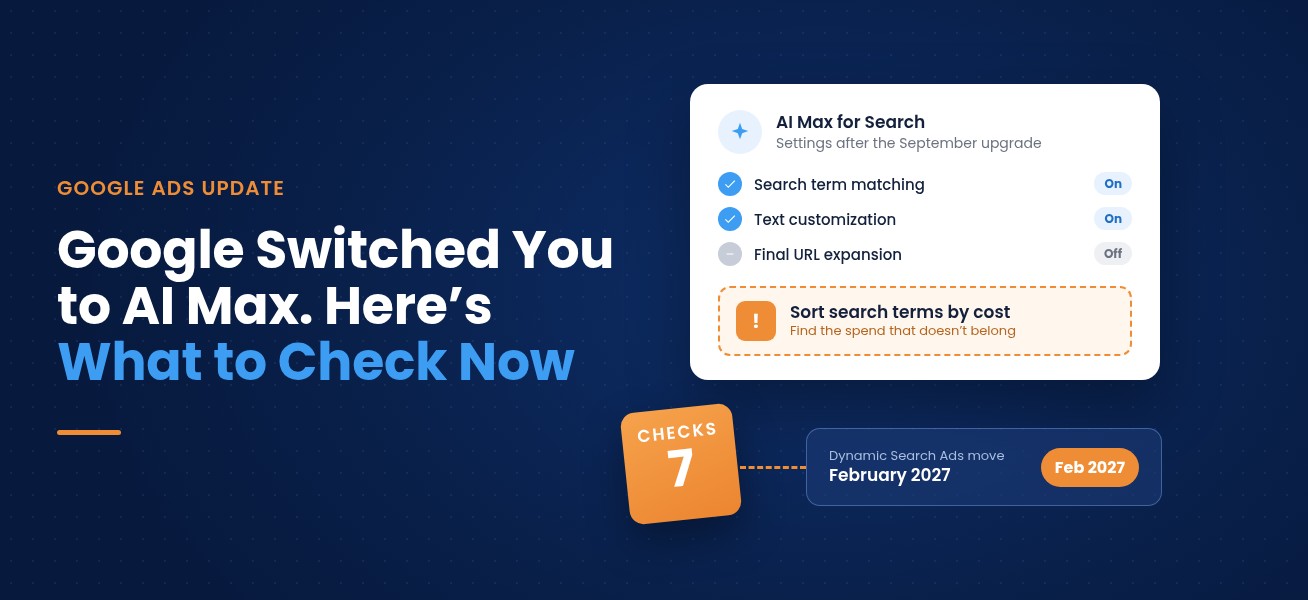
If a Search campaign in your account used automatically created assets or the campaign-level broad match setting, Google most likely moved it to AI Max for Search during September 2026. That means your ads can now match searches you never bid on, and Google may be writing some of your ad text. Every one of those settings can be changed or turned off. Below is the review we run on upgraded accounts before deciding what stays on.
Most of the accounts we opened in the first week of October had at least one campaign that was upgraded. Very few owners knew it happened. Google announced the automatic upgrade in April, updated the plan on June 11, and then pushed Dynamic Search Ads back to February 2027. The other two groups stayed on the September timeline.
Who got upgraded, and with what turned on
The upgrade wasn't the same for everyone. It depended on what the campaign was using before:
- Automatically created assets. These campaigns came over with search term matching and text customization both on.
- The campaign-level broad match setting. These came over with search term matching on.
- Dynamic Search Ads. Not yet. Google moved the DSA sunset to February 2027. When the switch comes, each dynamic ad group turns into a regular ad group running every AI Max feature, and the old URL controls come along.
One detail trips people up. Using broad match on individual keywords, without the campaign setting, didn't put a campaign in the forced group, as SEM Insider's audit guide points out. So look at campaign settings, not your keyword list. And anything you built recently may have AI Max anyway, because Google turns it on by default for new Search campaigns.
What each AI Max feature actually does
We explain it to clients this way.
Search term matching is the one that moves money. Google reads your keywords, ads and landing pages and then shows your ads on searches it thinks are related, even if nothing in your keyword list matches.
Text customization is what used to be called automatically created assets. Google writes extra headlines and descriptions from your website, your landing pages, your current ads and your keywords. If your site copy is thin or out of date, the ads it writes will be too.
Final URL expansion lets Google send the click to whatever page on your site it predicts fits the search. It only works when text customization is on. Neither September group had it switched on by the upgrade.
Google says advertisers using all three features see about 7% more conversions or conversion value at a similar CPA or ROAS, compared with search term matching alone. That figure comes from Google's own data on non-retail advertisers. It's an average across many accounts. It tells you nothing about how your account will do, which is why we test instead of assume.
The seven checks we run on an upgraded account
This is the same order our PPC team follows during a free PPC audit when AI Max is in the picture.
1. Make a list of what changed
Go campaign by campaign and mark which ones now show AI Max enabled. Compare that to what was live in August. Then open change history and note the date of the upgrade, so you have a clean line to measure before and after.
2. Write down which features are on
Open the AI Max settings in each campaign and record all three features. Don't trust that the upgrade defaults are still in place. A teammate, or one click on a Recommendations card, can flip a setting without anyone remembering.
3. Sort the search terms report by cost
AI Max matches are labeled with their own match type, so they're easy to isolate. Sort by spend, highest first, and read. Here's what we usually find by industry:
- Home services: "how to fix" and parts searches, job seekers, and towns outside the service area.
- Plastic surgery and medical: recovery and cost research from people who are months away from booking, plus procedures the practice doesn't offer.
- Auto dealers: other makes, private-sale searches, and parts or service searches leaking into a sales campaign.
- B2B: definitions, "free" tools, careers pages and competitors' support searches.
4. Compare 30 days before and after
Look at cost, conversions, cost per conversion and impression share. Then adjust for the season before you decide anything. An HVAC account in late September behaves differently from August whether AI Max is on or not.
5. Read the ads Google wrote
Where text customization is now on, open the asset report and read every generated headline and description. Remove anything wrong or off-brand. For medical practices, do this first. Generated copy can make a claim the practice would never sign off on, and that's a bigger risk than a few wasted clicks.
6. Add negatives and brand controls
Turn the junk you found into negative keywords. Use brand exclusions so a non-brand campaign doesn't pick up searches for your own company name, and brand inclusions when a campaign should only match certain brands. Dealers who sell one or two makes should spend time here.
7. Decide ad group by ad group
You can turn search term matching off at the ad group level. We leave it on where volume is low and conversion tracking is clean. We turn it off where tight control matters more than reach, like a high-ticket service where one bad week of clicks is expensive.
Fix tracking before you trust AI Max. It learns from whatever you count as a conversion. If your account counts a 40-second wrong number or a newsletter signup as a lead, AI Max will go find more of those for you.
Why conversion tracking comes first
Every automated feature in Google Ads, including AI Max and Smart Bidding, is only as good as the conversion data behind it. We've seen this play out for years. In our home builder case study, cost per acquisition fell 75% after we put proper website goals and call tracking in place and the budget could follow real results.
So before search term matching runs on its own, we confirm the primary conversions are actual leads. In practice that means CallRail for phone calls, clean form tracking, and offline conversions from the CRM where possible. If you use HubSpot, our guide to connecting HubSpot to Google Ads covers the setup, and our post on Google Ads offline conversion tracking explains how to bid on sales instead of form fills. We've also written about the most common conversion tracking problems and why Maximize Conversions doesn't always work.
If the tracking holds up, AI Max deserves a fair test. If it doesn't, we'd switch search term matching off until it does.
The controls you still have
Nothing about the upgrade is locked in. You can:
- Turn AI Max off for a whole campaign.
- Turn search term matching off for individual ad groups.
- Turn text customization off for a campaign, which also turns off final URL expansion.
- Use brand exclusions and brand inclusions.
- Add URL exclusions if final URL expansion is on.
- Keep using negative keywords at the campaign, ad group and list level.
Running Dynamic Search Ads? Use the months before February 2027. Google offers one-click experiments, so you can test AI Max against your current DSA setup on your schedule rather than Google's.
If you also moved Local Services Ads into Google Ads this year, the same discipline applies there. Our LSA to Performance Max checklist covers that migration.
Want a second set of eyes on your upgraded campaigns?
Our team will review what AI Max changed in your account: new search terms, generated ad text and where the spend moved. The PPC audit is free, and if your account is already in good shape, we'll tell you.
Frequently asked questions
Was my Google Ads campaign automatically upgraded to AI Max?
If a Search campaign used automatically created assets or the campaign-level broad match setting, Google scheduled it for the automatic upgrade during September 2026. Open the campaign settings and change history to confirm.
Can I turn off AI Max after the upgrade?
Yes. AI Max can be disabled for a whole campaign, search term matching can be switched off ad group by ad group, and text customization can be turned off too. Nothing the upgrade changed is locked in.
When do Dynamic Search Ads switch to AI Max?
Google pushed the Dynamic Search Ads sunset and automatic upgrade to February 2027. When that happens, each dynamic ad group is converted to a regular ad group with every AI Max feature switched on.
Does AI Max replace keywords?
No. AI Max uses your keywords, ads and landing pages as signals and matches beyond them. Your keywords, negative keywords and match types still work.
Is AI Max worth it for a local service business?
It can be, if your conversion tracking counts real leads and someone reads the search terms every week. Without clean tracking, search term matching tends to chase cheap conversions that never become jobs.
About the author
Michael Delpierre is CEO of Conversion Pipeline, a digital marketing agency he founded in 2009 with offices in Fairfax, Virginia and Nashville, Tennessee. The agency has been a Google Partner since 2012, and Michael works on paid search, SEO, HubSpot and CRM strategy for home services, medical, B2B and professional services clients.
Free audits
Find out where your ad spend and leads are leaking
Our free PPC audit digs into your Google Ads account for wasted spend, weak tracking and missed opportunities. Want the bigger picture? A free lead-source mini-audit shows which channels actually bring in your calls and form fills.