
By Michael Delpierre, CEO, Conversion Pipeline Published October 30, 2026.
If your Google Ads call conversions dropped this year while the phone kept ringing, this is likely the reason. Since April 2026, Google Ads records calls and uses AI to decide whether each one was a qualified lead. Only qualified calls count as conversions. Call length used to make that decision. Google calls the new system AI-qualified call leads, and it turned call recording on by default for most U.S. and Canadian accounts.
We noticed it first in home services accounts. Call conversions in Google Ads fell, sometimes by a third, while CallRail showed the same number of calls and the office said they were as busy as ever. Nothing was broken. Google had changed what it counts.
What changed in April
Google posted the help document on April 21, 2026, as PPC Land reported. The old rule was simple. If a call from your ad lasted longer than the threshold you set, it counted. Google's own explanation for dropping that is blunt: "a long call could still be a wrong number or a robocall."
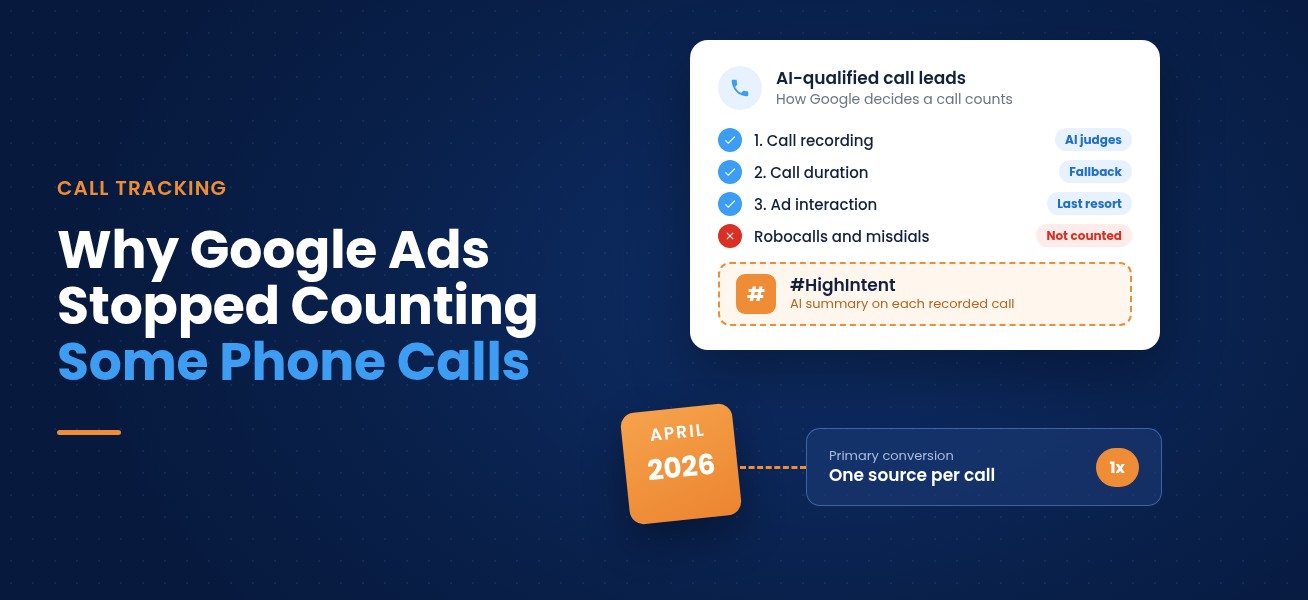
Now there's a pecking order:
- Call recording comes first. When recording is on, every call is recorded and the AI decides if it was qualified.
- Call duration is the fallback. If a call can't be recorded, it counts when it runs past your threshold.
- Ad interaction is the last resort. Without a Google forwarding number, conversions are classified from ad interaction data.
The AI listens for intent. A caller asking about a specific service, booking an appointment or sounding ready to buy. Your Call Details report now shows a short AI summary of each call, with tags like "#HighIntent" or "#ConsultationScheduled."
Why your call conversions went down
There are a few reasons. Not all of them are bad news.
Spam stopped counting
That's the point of the change. If robocalls that ran past 60 seconds were being counted, they're gone now. The number got smaller and more honest.
Some real calls don't sound "qualified"
The AI is listening for buying signals. An existing customer asking when the tech will show up, a vendor, or someone calling about last month's invoice probably shouldn't count as a new lead. But a homeowner who says "can you come Thursday?" and books in 30 seconds may not give the AI the signals it expects. Google hasn't published accuracy numbers, so spot-check.
Some calls can't be recorded
According to Google's call recording settings page:
- Both phone numbers have to be in the U.S. or Canada.
- The call has to go through a Google forwarding number, so call reporting must be on.
- Only calls from call ads, call assets and website visits qualify. Calls from location assets can't be recorded right now.
Anything outside those rules falls back to duration or ad interaction.
Healthcare and financial services work differently
If Google identified your business as healthcare or financial services, recording stayed off by default. So did any account that had already turned it off. Those accounts still count calls by duration unless someone turns recording on. For plastic surgery and medical practices, that's a decision for your compliance team, not just your ad agency.
Read this before you leave recording on
- Callers hear a notice. Google plays a short automated message at the start saying the call may be recorded for quality purposes.
- You're agreeing to terms. Call recording falls under Google's Call Ads Supplemental Terms, and Google says you confirm you've told your staff and anyone else on the line.
- Recordings do more than feed your reports. Google says it uses them to judge lead quality, watch for spam and fraud, and improve conversion reporting.
For a lawn care company that's usually fine. For a law firm, a med spa or anyone who discusses sensitive matters by phone, read the terms first.
What we check in an account with call conversions
1. Which conversion action is primary?
This is the first thing we look at, and it's wrong more often than you'd think. Some accounts have Google's call conversions and imported CallRail calls both set as primary. One phone call gets counted twice, and Smart Bidding learns from an inflated number. Pick one primary source for each kind of call and set the other to secondary.
2. Are call reporting and recording set on purpose?
Go to Admin, then Account settings, then Call ads. Check call reporting and the recording setting. Make it a choice someone made, not a default nobody looked at.
3. What's the duration threshold?
It still decides calls that can't be recorded. You'll find it under Goals, then Summary, then Phone call leads, then AI-qualified call leads, then Edit, then Lead qualification. For home services, the right number depends on how long your team takes to qualify a caller. Listen to a dozen calls and set it from what you hear.
4. Does the AI agree with your front desk?
Pull ten calls the AI counted and ten it didn't. Listen to all twenty. If it's rejecting calls that turned into booked jobs, you want to know that before Smart Bidding takes over.
5. Is your before-and-after fair?
Your call history now has a break in it. Comparing May through September with last year will show a drop that may be nothing more than cleaner counting. Use booked jobs or CRM deals as the yardstick that didn't change.
Smart Bidding, AI Max and Performance Max all learn from your conversions. Cleaner call data is good for them, but only if one source counts each call once. We covered how AI Max uses that data in our AI Max audit checklist.
Google's call tracking or CallRail?
We use both, for different jobs. Google's system tracks calls from your ads and website visits and feeds them to Smart Bidding automatically. CallRail uses dynamic number insertion to give each traffic source its own number, so it tracks every channel: organic search, social, direct mail, even billboards. It records and scores calls and sends them into GA4 and HubSpot. You can also import CallRail calls into Google Ads so bidding learns from the calls your team marked as qualified.
That full picture is what made the difference in our home builder case study. Once call tracking was on the website and every print piece, the data showed print cost more and converted worse than digital. The budget moved, and cost per acquisition dropped 75%.
What you shouldn't do is run both as primary for the same calls. For more, see why call tracking drives lead generation, the most common conversion tracking problems, and how to send closed jobs back to Google with offline conversion tracking.
Missed calls are a separate leak
If you run Local Services Ads, Google now charges for some calls you don't answer. Our post on LSA missed-call charges explains the rule, and what missed calls cost a home service business shows how to put a dollar figure on it.
Want to know which calls you're really counting?
Our free lead-source mini-audit checks how your Google Ads account counts calls, whether anything is counted twice, and how reported conversions line up with calls that turned into jobs. We'll go through it with you on a 15-minute call.
Frequently asked questions
Why did my Google Ads call conversions drop?
Since April 2026, Google Ads counts a recorded call as a conversion only when its AI judges the call to be a qualified lead. Spam, robocalls and misdials that used to pass the duration threshold no longer count.
Is Google Ads recording my business's phone calls?
For most U.S. and Canadian accounts, yes. Call recording was turned on by default for AI-qualified call leads. It stayed off if you had already turned it off or if Google identified your business as healthcare or financial services.
How do I turn off call recording in Google Ads?
Go to Admin, then Account settings, open Call ads, set Call recording to Off and save. Google then falls back to call duration to measure conversions.
Do AI-qualified call leads apply to medical practices?
Call recording is off by default for businesses Google identifies as healthcare, so those accounts measure calls by duration unless someone turns recording on manually.
Should I use Google call tracking or CallRail?
Many businesses use both: Google's call tracking for ad calls and CallRail for every source. Just make sure only one of them is the primary conversion for the same calls.
About the author
Michael Delpierre is CEO of Conversion Pipeline, a digital marketing agency he founded in 2009 with offices in Fairfax, Virginia and Nashville, Tennessee. The agency has been a Google Partner since 2012, and Michael works on paid search, call tracking, HubSpot and CRM strategy for home services, medical, B2B and professional services clients.
Free audits
Find out where your ad spend and leads are leaking
Our free PPC audit digs into your Google Ads account for wasted spend, weak tracking and missed opportunities. Want the bigger picture? A free lead-source mini-audit shows which channels actually bring in your calls and form fills.